
Particle Size Distribution testing influences product performance, safety, and regulatory acceptance across industries. It affects flowability, dissolution, texture, optical properties, and emissions control. Methods vary by scale and material: laser diffraction and imaging for broad micron ranges; dynamic light scattering for nanoparticles; sieving and sedimentation for coarse minerals; cascade impactors and aerodynamic sizers for aerosols. Sample prep, throughput, and accuracy drive method choice, and combining techniques resolves ambiguities. Continue for practical guidance and industry-specific examples.
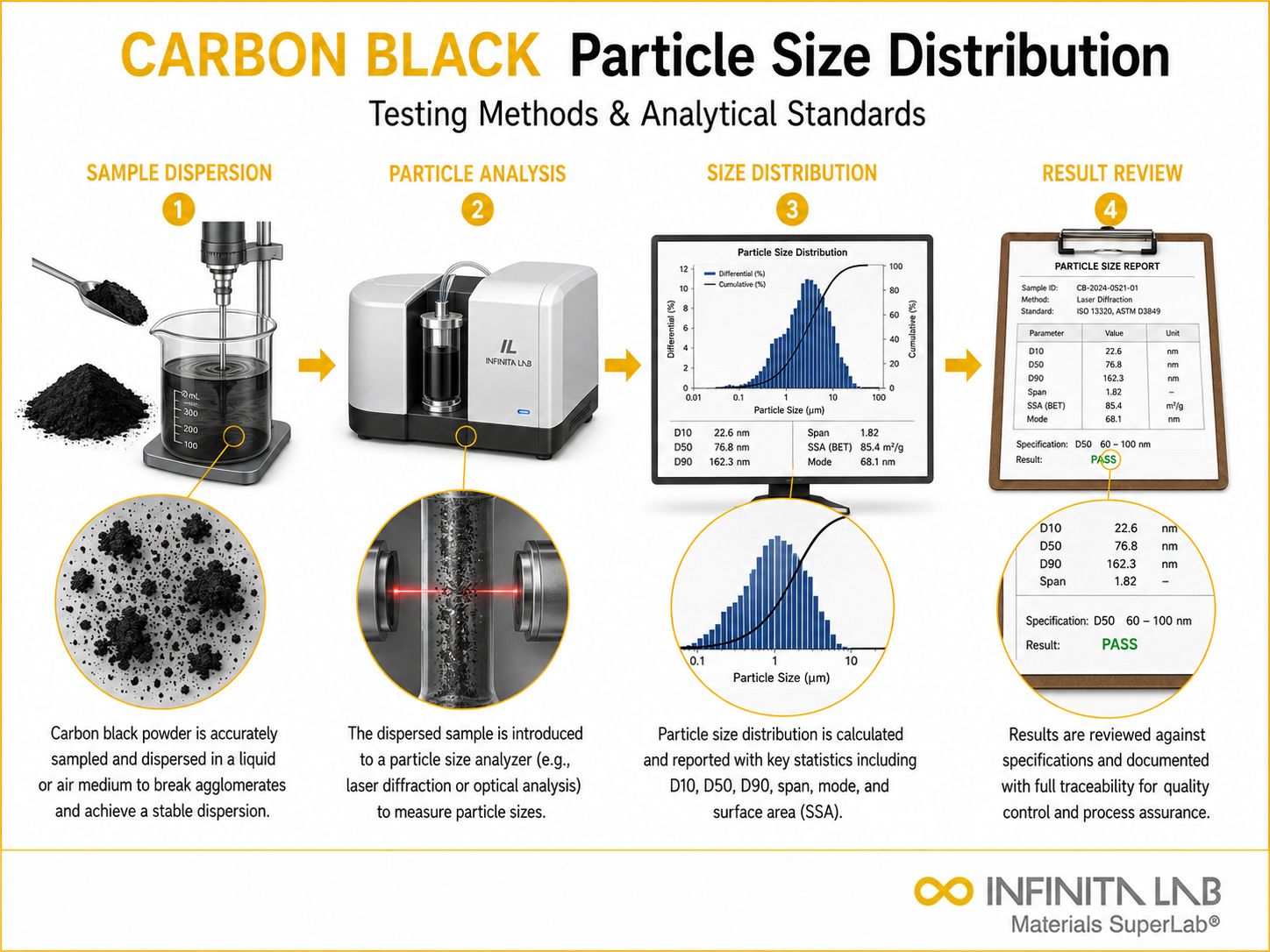
Particle-Size Effects on Product Performance and Compliance
When particle size varies, product behavior and regulatory compliance can change in predictable and measurable ways. Industry stakeholders observe that fines, mean diameters Lab Alliance, and size distributions alter flowability, dissolution rates, and mixing uniformity.
Smaller fractions increase surface area, accelerating reactions and bioavailability, while larger particles improve handling and reduce dust. Regulatory thresholds often reference specific size metrics; meeting those limits enables market access and operational freedom.
Quality teams balance performance targets against compliance constraints, selecting processing parameters that produce desired profiles without triggering additional controls. Clear specifications and routine monitoring reduce risk and preserve innovation space.
Decision-makers prioritize adaptable methods that deliver repeatable distributions, allowing products to perform reliably while satisfying regulatory obligations.
Particle-Size Measurement Methods by Particle Type and Range
Recognizing that specific performance and compliance outcomes depend on precise particle characteristics, the discussion now shifts to how measurement approaches are selected according to particle type and size range. Methods align with morphology, composition, and scale:
Light scattering and laser diffraction suit broad submicron to millimeter distributions for spherical or near-spherical particles.
Dynamic light scattering targets nanoparticles and colloids.
Acoustic and sedimentation techniques handle dense, irregular aggregates.
Electron and optical microscopy provide shape and surface detail across nano-to-micron scales where counts and imaging matter.
Surface-sensitive methods (BET, XPS) complement size data for porous or reactive materials.
Choice balances resolution, throughput, sample preparation, and non-destructiveness.
Proper method selection enables meaningful, comparable data while preserving analytical freedom and operational practicality.
Industry Map: Which Particle-Size Tests Are Used in Pharma, Food, Paints, Mining, Environment
Across industries, particle-size testing is selected to meet specific performance, safety, and regulatory needs. The pharmaceutical sector emphasizes tight control for bioavailability and stability, favoring laser diffraction and microscopy for API and suspension characterization.
Food producers monitor texture and mouthfeel, using sieving, laser methods, and image analysis to control consistency and shelf life.
Paint and coatings manufacturers rely on laser diffraction and dynamic light scattering to tune opacity, flow, and film formation.
Mining and minerals adopt sieve analysis, sedimentation, and laser techniques for ore grading and process efficiency.
Environmental monitoring applies cascade impactors, aerodynamic sizers, and optical counters to assess airborne particulates and waterborne sediments against health and compliance benchmarks.
Each industry balances practicality, interpretability, and regulatory alignment.

Choosing Particle-Size Tests: Sample Prep, Measurable Range, Accuracy, and Throughput
Selecting an appropriate particle-size test requires matching practical constraints—sample preparation, instrument measurement range, accuracy requirements, and throughput—to the specific material and decision context.
The evaluator considers how much preparation a method demands: dispersion, drying, or labeling steps can alter particles and limit choices. Measurement range defines suitability for nano to coarse fractions; methods with narrow dynamic ranges may necessitate complementary techniques.
Required accuracy and resolution drive instrument selection: tight specification control or regulatory compliance favors high-precision approaches, while exploratory screening tolerates lower fidelity.
Throughput constrains selection when many samples or rapid feedback are needed; automated or inline systems support operational freedom.
Cost, consumables, and operator skill remain practical modifiers influencing the final test choice.
Common Pitfalls, Troubleshooting, and When to Combine Particle-Size Techniques
When tests yield inconsistent or implausible size distributions, the cause is often methodological—improper dispersion, optical artefacts, or inappropriate data inversion—rather than an intrinsic property of the sample. Analysts should systematically check dispersion protocols, detector alignment, refractive index settings, and inversion parameters.
Cross-checks with orthogonal methods reveal biases: laser diffraction underestimates fines if aggregates persist; imaging misclassifies overlapping particles; sedimentation struggles with non-spherical shapes. Troubleshooting follows isolation: replicate with altered dispersion energy, dilute concentrations, or alternative solvents; inspect raw signals and images; validate with standards.
Combining techniques is pragmatic when single methods leave ambiguity—use imaging for shape, light scattering for broad-range statistics, and sieving or sedimentation for coarse fractions. Freedom-seeking practitioners favor flexible, evidence-driven method suites.
Conclusion
Particle-size characterization underpins product performance, regulatory compliance, and process control across industries. Selecting appropriate measurement methods requires matching particle type and size range to analytical capabilities while considering sample preparation, accuracy, and throughput. Common pitfalls—aggregation, inadequate dispersal, and misapplied techniques—can be mitigated through method validation and combining complementary approaches. Ultimately, informed test selection and rigorous troubleshooting guarantee reliable data that drive formulation optimization, quality assurance, and meaningful comparisons across pharmaceutical, food, coatings, mining, and environmental applications.
…